
Aktuelles
2026-04-17
According to research by McKinsey, IDC, and other institutions, the AI Human Machine Interface is evolving from a single display system into a human-machine interaction hub that integrates multiple systems. Multi-camera and AI perception technologies have become core components. As an important part of STONKAM AI Human Machine Interface product portfolio, the AI Vehicle Camera Monitoring System integrates multi-channel video, AI algorithms, and human-machine interaction technologies to build safer and more intuitive surrounding perception capabilities for drivers.
The AI Vehicle Camera Monitoring System is an in-vehicle safety system that integrates Visual AI Perception with intelligent algorithms. The system uses multiple cameras to capture the vehicle's surroundings in real time, fuses and optimizes the data via AI algorithms or video processing units, and presents the visualized results on in-vehicle display terminals, thereby replacing traditional optical rearview mirrors and expanding the vehicle's visual capabilities.
Through the synergy of visual sensors and intelligent algorithms, the AI Vehicle Camera Monitoring System fundamentally reconstructs multi-perspective visual perception for the vehicle, enabling drivers to "see more completely, see more clearly, and see more intelligently." It evolves from a simple visual replacement solution into a key perception and information interaction system for the AI Human Machine Interface.
1. Improve driving safety under complex working conditions
In challenging environments such as night, rain/snow, strong backlight, or dust, the system provides more stable and clear visual output, helping drivers more accurately assess surrounding risks.
2. Reduce driving burden and improve operational efficiency
The in-vehicle display centrally presents multi-channel video information, reducing the need for drivers to frequently turn their heads, thereby increasing driving focus and operational efficiency.
3. Align with intelligent and regulatory upgrade trends
According to UN ECE R46 regulations and research by McKinsey and other institutions, AI Vehicle Camera Monitoring System is gradually becoming an important development direction for electronic rearview systems, aligning with global trends in vehicle intelligence and regulatory standard upgrades.
In essence, the AI Vehicle Camera Monitoring System integrates "cameras + AI + display," fundamentally reconstructing the vehicle's multi-perspective visual perception capability.
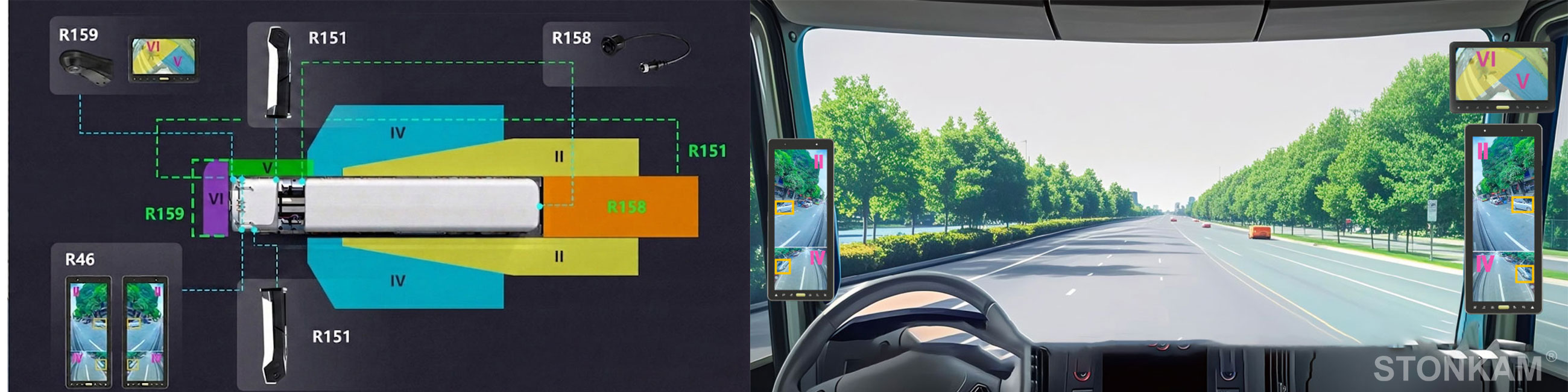
1. Mirrorcam System
STONKAM mirrorcam system can replace traditional optical rearview mirrors and become an important component of the AI Human Machine Interface.
Compliance and safety dual assurance: The system is designed according to the ISO 26262 functional safety standard and has passed UN ECE R46 regulations. It also meets R151, R159, R158, R118, R10, and GB15084-2022, covering Class II, IV, V, VI blind-spot fields of view, with comprehensive safety and compliance capabilities.
Strong all-weather visibility: Compared with traditional rearview mirrors, it provides a clearer and wider field of view, maintaining good visibility even under complex conditions such as night, rain/snow, or strong backlight, effectively reducing blind-spot risks.
Lower usage and maintenance costs: The system integrates auto backlight adjustment, auto heating & defogging, self-cleaning, and auto folding functions, reducing maintenance costs. It can also automatically adjust the dynamic viewing angle range according to trailer status, reducing blind spots and further enhancing driving safety.
2. Built-in algorithm in-vehicle video recording AI monitors system
Features algorithmic and intelligent analysis capabilities, capable of processing and recording multi-channel video to achieve higher-level risk identification and driver assistance.
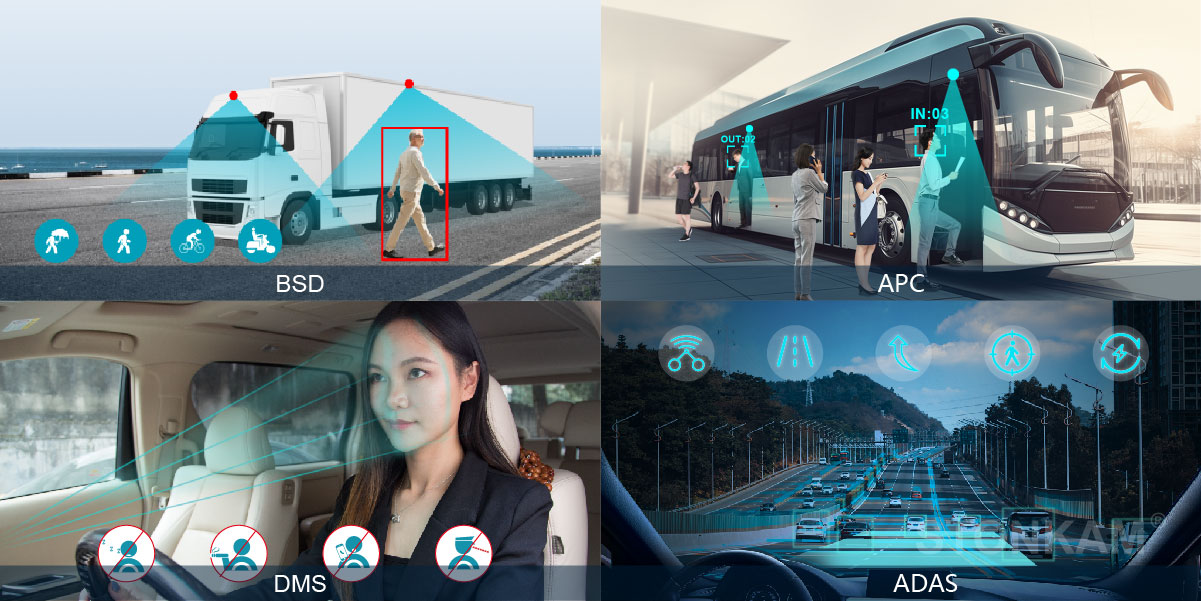
Multi-algorithm intelligent analysis: Supports mainstream algorithms such as ADAS, BSD, DMS, and APC, and allows algorithm customization based on requirements. It enables real-time perception and alerts for abnormal situations involving people, vehicles, and roads during driving, providing more accurate support for safe driving.
Loop recording function: Supports 512GB TF card storage with an automatic loop recording mechanism, enabling long-term continuous video recording and ensuring the retention of critical driving data for multi-scenario traceability needs.
All-in-one in-vehicle DVR and AI monitors: Built-in GPS, Wi-Fi, and 4G communication modules, eliminating the need for an external DVR device to achieve an integrated in-vehicle monitoring solution. It also supports access to CMSV6/WIALON platforms and the JT808 protocol, enabling remote real-time vehicle monitoring and management, effectively improving fleet operational efficiency and management level.
3. Conventional high-definition AI vehicle monitor system
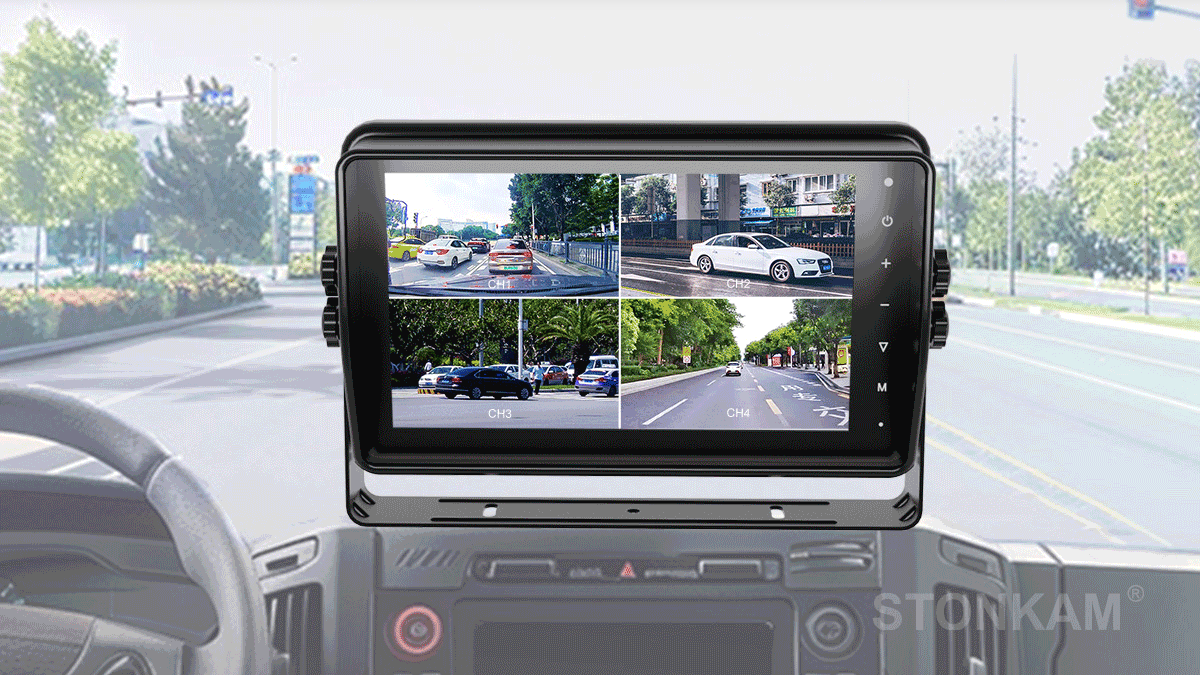
Supports centralized display of multi-channel video, flexibly adaptable to different vehicle types and application requirements, achieving unified presentation of multi-perspective information and improving driver information acquisition efficiency.
IPS high-brightness display: Uses a 1024×600 high-resolution IPS screen with high contrast and high brightness, delivering true and natural color reproduction, clear and detailed images, and stable display of critical visual information.
Multi-display modes: Supports 4-channel 1080P AHD camera input, offering various display modes such as Monoview, dual view, Quadview, and Six-View. It allows real-time switching between multiple monitoring views, making driving information more intuitive and clear at a glance.
1. Addressing operational challenges in reversing, loading/unloading, and complex work environments
STONKAM AI Vehicle Camera Monitoring System supports centralized display and switching of multi-channel video, providing drivers with a wider field of view. Drivers can comprehensively monitor rear, side, and working areas from the cab without frequently turning their heads or switching devices, improving operational efficiency and safety.
2. Solve blind-spot hazards of large vehicles
STONKAM AI Vehicle Camera Monitoring System can perceive and monitor all abnormal situations involving people, vehicles, and roads during driving, offering an optimal solution for driver assistance.
3. Solve problems of traditional rearview mirrors susceptible to vibration, rain, and contamination
STONKAM AI Vehicle Camera Monitoring System uses electronic imaging, which is unaffected by mechanical vibration. It also features waterproof, anti-fog, and anti-interference capabilities, ensuring continuous and stable visual output.
As the perception and interaction core of STONKAM AI Human Machine Interface product portfolio, the AI Vehicle Camera Monitoring System is redefining the "field of view boundaries" in actual driving and working scenarios. It not only provides clearer and more reliable environmental information under complex working conditions but also, through algorithm integration and regulatory compliance design, offers a solid foundation for fleet safety operations and intelligent upgrades.
As global intelligence accelerates, STONKAM will continue to drive technological innovation in the AI Vehicle Camera Monitoring System, helping every vehicle build a smarter and safer cockpit experience.
Q1: What is the AI Vehicle Camera Monitoring System?
The AI Vehicle Camera Monitoring System is an intelligent safety system that integrates camera perception, AI algorithms, and in-vehicle display terminals. Through multi-channel video capture and fusion processing, it visualizes the surrounding environment inside the vehicle, thereby expanding the vehicle's overall visual perception capability. It is an important component of the AI Human Machine Interface.
Q2: What are the benefits of the AI Vehicle Camera Monitoring System for fleet operations?
The AI Vehicle Camera Monitoring System can improve overall fleet safety and operational efficiency by providing real-time perception of the vehicle's surroundings through multi-channel video, reducing collision risks caused by blind spots. It offers clear visual assistance during reversing, turning, and complex working scenarios, reduces driving burden, improves driving focus and response efficiency, and lowers accident rates and operational maintenance costs, helping fleets operate safely and efficiently.
Q3: How does the STONKAM AI Vehicle Camera Monitoring System enable efficient fleet management and intelligent driving alerts?
The system integrates multi-channel video capture, AI analysis, and in-vehicle display to enable real-time environmental monitoring and intelligent decision support. At the fleet level, it improves operational visibility and standardization. At the safety level, it identifies pedestrians, vehicles, and potential risks, providing early warnings that shift protection from passive monitoring to active safety intervention.
Q4: Where can the STONKAM AI CMS Vehicle Monitoring System be used?
The system is widely applicable to commercial vehicles, construction machinery, and special-purpose vehicles. It supports scenarios such as reversing, loading/unloading, complex road conditions, and high-risk operations, enabling comprehensive environmental perception and safety assistance.
STONKAM CO., LTD
Adresse: 1/F.,#6Building,Huangzhou Industrial Park, Chebei Rd.,Tianhe,510660 Guangzhou,China
Tel: (86-20)6667 0988
Fax: (86-20)6667 0977
E-mail: sales@stonkam.com
WhatsApp: +86 15521270579; +86 15708917305

Copyright ©2002-2022 STONKAM CO.,LTD. 广州敏视数码科技有限公司 ALL Rights Reserved. 广东省通信管理局 粤ICP备05043268号





 AI
AI  AIoT
AIoT  360° Rundumsicht-Systems
  Erkennungssensors
  Hochauflösende Monitores
  Analog Kameras
  Digitale Kameras
  CMS
CMS  AI Drahtlos
  Regelungen
  Wärmebildkameras
  OEM-Lösungen
  Industrieanwendungen
 Erfolgsgeschichten
  Aktuelles
 Videozentrum
 Einführung
  Warum STONKAM®
  Kultur
  Meilenstein
  Zertifikate
  Kontakt
  Unterstützung